Pages

Showing posts with label moderate spicy. Show all posts

Tuesday, August 11, 2020

মুসুর ডালের বড়া -- Red Lentil Fritters

 During this pandemic our consumption of rice and lentils has increased and that of fresh vegetables has decreased only to ensure maximum physical distancing and isolation. Therefore, we are having red lentil fritters more often than usual.


We had red lentil fritters tonight also. Two days ago I soaked some lentil and made fritters with some of it. The rest was in the fridge. We had to use it up, too. 

This fritter is super easy to make: soak >make the paste> add salt, a little shredded onion and green chillies, a little turmeric powder > stir, stir, stir to mix well > fry. And Voila! No need to deep fry! The only difficult task is to make the paste if you do it manually using the traditional শিল-নোড়া, the two pieces of stones with which Bengali women have been making pastes of almost everything under the sun since time immemorial!! 😅 But I suggest you use a mixer-grinder. Our mixer is kaputt and cannot take it to the shop for fixing unless the infection rate starts reducing. Almost every day we are at the top of the list in daily infections and death. For the same reason I can't get my spectacles replaced; so, Mom did the frying. Two days ago I did it without my glasses but we shouldn't take such a risk since the entire medical service is under tremendous pressure and treatments to other medical conditions are not happening regularly and so, this is not the most convenient time to have an accident in the kitchen. 

The Paste
The Paste
Soaked Dal on the Flat Stone
Soaked Dal on the Flat Stone(শিল)

Instead of onion I prefer adding nigella seeds. I also don't add turmeric powder. 

Make the shapes flat; then the lentil will cook thoroughly though you don't deep fry. We never deep fry lentil fritters. 

It's heavy and oily. I wouldn't give it to very small children. But it tastes simply out of this world and a very common side dish with জল-ভাত /jawl bhaat/ in summer and a popular traditional part of the Iftaar menu as our poet শামসুর রহমান(Shamshur Rahman) reminds us in his poem 'বাংলাভাষা উচ্চারিত হলে': "নানী বিষাদসিন্ধুর স্পন্দে দুলে / দুলে রমজানী সাঁঝে ভাজেন ডালের বড়া"

Red Lentil Soup + Red Lentil Fritters with Rice


Thursday, June 16, 2016

Cauliflower Curry

Alu-Phulkopir Torkari: Traditional Bengali Cauliflower Dish

       Cauliflower is mainly our winter vegetable. Nowadays, though, thanks to technology, we can find at least some small cauliflowers here and there in the market throughout the year. Of course, the off-season products are very costly. I cooked this dish a few months earlier but could not have the opportunity to post it. Cauliflower is one of my most favourite vegetables and I cook this dish quite often.
       I cut the potatoes into small and the flower in comparatively bigger pieces. The quantity of potato is much less than the flower and you can even prepare this dish without potato. I heat oil ( this time I used mustard oil) till the smoking point and sautee the potatoes and keep them at one side. I add the seasoning cumin seeds and chopped green chili to the oil and then add the cauliflower pieces. I stir and let it cook and after a while add cumin powder and turmeric powder and stir a few more times to mix everything. I cover it now and let it cook for a while on low flame, but not for long to make sure that it does not get burnt because I do not add water at this point. Now I add a little very thinly sliced tomato, usually a half of one big tomato if I cook a small flower and fresh green peas (we almost never use frozen peas), stir a little and now add water. I let it cook by covering the pot till everything is done and then add salt ( and ideally a little sugar which I didn't use), mix well and let it cook for may be one minute.
        I like it with thick gravy. If you prepare it often, you can guess how much water to add and when and how often you must stir. I had it with steamed rice but it also goes very well with Roti or Luchi
Cauliflower and Potato Curry


Before Adding Water

Thursday, June 2, 2016

Sabudana Khichdi

Popular Breakfast Dish of Tapioca Root Globules

         Sabudana Khichdi is my favourite Maharashtrian dish. It is very easy and quick to cook, too. Other Maharashtrian dishes I love are Sabudada Vada (Tapioca globule fritter) and ALuvadi (Taro leaf fritter) which I have not yet learnt to prepare. 
         This is my first attempt to make Sabudana Khichdi, a popular breakfast dish or a dish typical to break fast with, literally after a long day of fasting. I didn't find bigger globules in the the shops in my locality but I so felt like having this khichdi that I decided not to wait. I soaked the tiny pearls of sabu that we had at home for about two hours. In the meantime I boiled potato in the pressure cooker.I made sure that the potato did not cook two soft. I peeled the boiled potato (after it cooled down, of course) and cut into small cubes. I already had some roasted ground nuts ready, I just rubbed the peels off. 
         I used ground nut oil to cook this. I heated some oil and added chopped green chillies and whole cumin seeds. Unfortunately, I didn't have curry leaves. It is an essential ingredient in fact. I added the potato, sauteed it, added salt and red chili powder, stirred to mix every thing well and let it cook for a while. Since the potato was boiled already, it didn't take much time and the potato cubes started turning golden soon. I added the nuts and mixed everything thoroughly. Traditionally, roughly crushed ground nut is also added which I did not use. Last went in the sabu globules. I kept stirring carefully so that the sabu doesn't form lumps and also everything mixes well. It was ready to serve in a few minutes. It was our evening snack. Usually Sabudana Khichdi is served at breakfast but nowadays I don't have breakfast but I sleep the morning away! I must change this habit!


Sunday, August 30, 2015

Ridge Gourd with Muastard Paste


Ridge gourd, Luffa acutangula, is the main ingredient of a very popular traditional Bengali plant based dish called "alu jhinge posto", i.e. ridge gourd and a little potato cooked with poppy seed paste. Ridge gourd is a close relative of the less popular sponge gourd, L. aegyptiaca, which was traditionally used in Bengal to make loofah by letting it ripen and then dry in the plant itself, then it is very fibrous, one just has to take the dried and hardened skin off which can be done with naked fingers and if you shake it vigorously, the dry black seeds will come off, too! It is eaten , too, when it is very young. 
But today, I am not going to post alu jhinge posto recipe here. Rather, I have decided to share a less famous and less common but no less tasty ridge gourd dish that is without potato. So, here is my favourite ridge gourd with mustard paste.


I peeled the gourd and cut into big cubes. I heated mustard oil and added sliced green chilli and mustard seeds and immediately added the gourd. Then I added turmeric powder and salt to it and stirred and mixed very well. Then I covered the pan with a lid. Water will start coming out from the gourd. I don't add water into it.
After the gourd is half cooked, I add the mustard paste, stir to mix it well and leave it cook further. If I find that a  lot of water has come out, I don't cover it again.
After the gourd is thoroughly cooked it is ready to serve. I always have it with steamed rice.

This is how I prepare the mustard paste: --
To make the mustard paste, I soak it in cold water for a long time, say, half an hour. If I want it hot and spicy, I add fresh green chilli to it. After the paste is made, I add a little water to it and strain it through a sieve to remove the husk. This is how we make sure that the dish doesn't get bitter because mustard can taste a bit bitter.

Saturday, January 26, 2013

Mourola Machher Chachchori

Anchovies with Egg plant and Potato

Main course
Serves two

Preparation time: 25 minutes
Cooking time: 20 minutes

Ingredients:

Mourala fish: 100 gm
Potato: 50 gm
Egg plant: 50 gm
Green chili -- two small
Onion -- 25 gm
Turmeric
Salt
Sugar -- a pinch (optional)
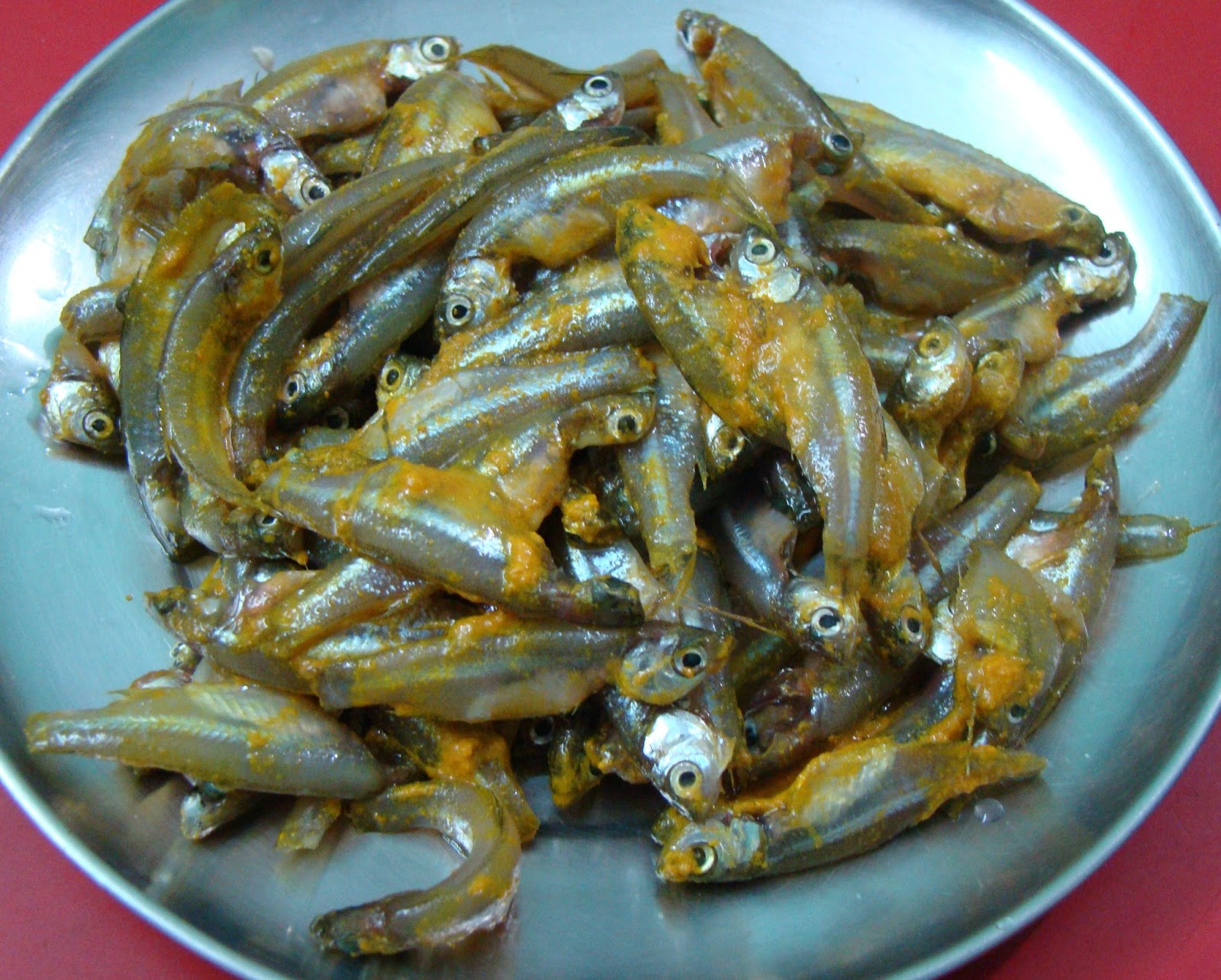
Mourala Fish in Salt and Turmeric

sliced green chili, shredded onion, potato, egg plant

How to prepare:
Clean the fish. This will take considerable time.
Marinade the fish in salt and turmeric.
Cut the vegetables as shown in the picture above.

Fry the fish. Keep at one side.
Fried Mourala
Add potato to the oil and saute. As the potato starts turning golden, add the green chili and onion into the oil. Saute a little.
Add the egg plant. Saute. Stir a little. 
Add turmeric and salt.
Stir well to mix well. 
You may add very little water.
Cover the pan and make the flame small.
As the vegetables are almost done, add the fish. Stir to mix well.
Cover and let everything cook on small flame for about five more minutes.
Serve with steamed rice.


Saturday, January 12, 2013

Cabbage Pakora

Snacking is easy and fun!

Serves 6 -- 8

Ingredients:

Cabbage – very finely shredded – 500 gm
Besan – chick pea flour (gram flour) 100 gm
Onion – shredded – 100 gms.
Salt
Turmeric powder (optional)
Green chili – finely chopped -- one
Water
Sunflower oil
Sugar – half a tea-spoon

Preparation time: 

15 minutes

Cooking time: 

about 5 minutes on small flame (depending on the size of the frying pan, how many pakoras you can fry at a time)

How to prepare:

Shred the cabbage.
Add salt and sugar (and turmeric powder) to the besan and mix very well.
Add water little by little to this mixture of besan and salt to make a thick paste.
[Or you can add the salt (and turmeric powder) to the water and after the salt is dissolved in it, add this water to besan to make the paste. But do not add salt after mixing besan and water because salt will not mix uniformly in a paste.]

Now mix this paste and shredded cabbage, shredded onion, and finely chopped chilies all very well together.


 Make small flat circular shapes, like tiny pan cakes and dip fry them over low flame. Serve hot with puffed rice (muri).
Cabbage Pakora

Note: While frying you have to make sure that the cabbages are cooked soft enough but not over-fried or burnt. If you have a big pan, you can fry all the pakoras at one go. If your pan is smaller, the cooking time will increase.
If you prefer using less oil, you can also go for shallow fry. Then, make your pakoras flat and turn them over while frying to make sure that they are well cooked from both sides.

Saturday, January 5, 2013

Mankochur Torkari

Taro Roots with Potato
Serves 4

Ingredients:

Taro root – 500 gm
Potato – 200 gm
Salt
Turmeric powder– one tea-spoon
Bay leaves (dried) -- two
Cumin seeds – a pinch
Green chilies – two small (sliced)
Ginger paste/ powder – half a tea-spoon
Cumin paste/ powder – 2 teaspoons
Coriander paste/ powder – half tea-spoon
Mustard oil (or sun flower oil) – one and a half table-spoons
Water


How to prepare:

Cut taro and potato in small cubes, wash with water and drain all the water carefully. Keep these in one side.
Heat mustard oil until the colour changes and the typical smell of mustard oil vanishes.
Add bay leaves, green chilies and cumin seeds.
Add the vegetables; add salt, sauté for some time, till taro starts turning golden by stirring it now and then. Add ginger paste. Stir a little. Add turmeric, stir and mix well. Add Cumin- and coriander paste/ powder, and just like before, stir and mix well. Add water. Add sugar. Cover and now make the flame small. Let it cook in low heat until the vegetables get tender. By then the gravy will also thicken. Serve with steamed rice or roti.

Begun Chachchorhi


Side dish
Serves 4


Ingredients:

Brinjal (begun, "eggplant") – 500 gm
Mustard paste – 3 tea-spoons 
Nigella – “black Caraway” (Kalo jeeray) – a pinch
Salt,
Sugar -- a pinch
Turmeric powder – half a tea-spoon
Mustard oil (or sun flower oil) – one tablespoon
Green chilies -- 2 small
Coriander leaves (shredded)


How to prepare:

Cut Brinjal into small pieces.
Heat oil. Add nigella and thinly sliced green chilies to it.
Add brinjal pieces. Add salt. Make the flame small. Cover. Let it cook till the brinjal becomes a little brown. Add turmeric. Stir well. Cover. Let it cook till the brinjal becomes soft. From now and then stir as the brinjal cooks.
Now, as the brinjal has become tender, add the mustard paste. Stir well so that it gets mixed well. Add coriander leaves. Cover and cook further for about 5 minutes. 
Serve with steamed rice.
  

Tuesday, November 27, 2012

Luchi and Mangsho


I can't remember when I experienced luchi after I left West Bengal.
Luchi is a deep fried flatbread made of bleached wheat or maida and much more, much more than just something delicious to eat! Luchi means a puja (worship), a birthday clebration; luchi means a Sunday breakfast! When luchi is there, we know we are going to have payesh or halua and/or alur dom or mangso or alubhaja or chholar dal! Luchi is closely associated to festivity, to happy occasions! That is why I used "experience" instead of "eat" or "have".

In Germany I never prepared luchi or roti although I cooked for my friends often but always chose something I could cook fast, even though the preparation before cooking was long sometimes. Every time I had such a party, I wished if my sister could be there! So, I decided to cook chicken curry which was popular among my friends in India and abroad and luchi for dinner because my sister loves chicken and I missed luchi.
                                                               Luchi


                                             Murgir Mangsho: Chicken Curry
I bought sandesh and lal doi to have at the end. We, Bengalees, love sweets and our meals must end with some sweetness: madhureNa samapayet!
                                               Lal Mishti Doi and Sandesh
Not just in our food culture, the popular luchi has its well-desereved place in our literature as well.
Who among us doesn't feel nostalgic about the popular rhyme by Mohit Ghosh: "phulko luchi phulko luchi/ pet ta phule dhak/ phulko luchi phulko luchi/ peter bhitor phank!/ "?
But not all children can enjoy luchi since their parents cannot afford it. Examples are Apu and Durga, the young protagonists of "Panther Panchali" by Bibhutibhushan Bandopadhyay, another classic of Bangla (Bengali) literature: Apu felt happy seeing luchi on his plate as he accompanied his father to his disciples' house and sad too, at the same time, since he could not share it with her sister at home. Luchi is something they seldom had.

Sunday, December 18, 2011

Bengali Lunch for My Friend from Maharashtra


---- alu-bean bhaja, dimer jhol ar bhat
This year on the occasion of Diwali (the festival of lights), I was invited to have some special homemade Maharstrian delecacies at a friend's house. Her mother vited her from India and was actually staying with her when we met on Diwali. There after a really long time I had karaunji, chakli, chiwda, everything homemade! I never expected before that I would have a so Indian Diwali this year.
I also felt like cooking something authentic Bengali for them.
Unfortunastely Auntie left before we could manage some time to cook together.
So, I cooked for her daughter!
We had alu-bean bhaja (potato and green beans friend)and dimer jhol (egg curry).
Basically the same recipe I sent to BBC: http://www.bbc.co.uk/worldservice/learningenglish/specials/2009/11/091126_recipes_nov2.shtml where it looked different because there it was "kasha" (very thick gravy)here it is jhol ("=gravy/sausse"), more liquid.

Prawn in Onion and Tomato: My Success with Microwave!

WE learn only when we are forced to learn; when the situation we are in demands that we must learn. I did not touch the microwave oven in my flat for the last one year. But in the recent past, as my oven broke down twice in three weeks, I realized that I must have a parallel system to avoid unintended fasting in a Sunday late evening. (On Sundays everything is closed in Germany.)
So, I tried utilising the presence of the “Mikrowelle” in my kitchen. It actually went so well that I bought some ceramic pots, made in France, specially made for cooking in microwave oven. They are orange and white in colour. They are beautiful!
So, nowadays I am cooking even typical Bangali dishes, too, in microwave oven.
Here is prawn with tomato and onion, the way my mom used to cook it quite often. Only, I did not add thinly sliced potatoes to it since I feel that I eat too much carbohydrate. Sorry, I was too hungry to present it more neatly in a better container this time. I apologise for this not-so-good photo.

Tuesday, October 4, 2011

Peas and Sausage Fried Rice

Nowadays I go to gym because I eat like this:


This is my sausage fried-rice!
The meat in the sausage was from poultry.
I used butter instead of oil to make it tastier because butter makes everything yummy! This was a very successful experiment.

Sunday, September 11, 2011

Beet-er Tarkari (Beetroot curry)


Beetroot curry and laal shaak (tiny red leafy plant)were my favourites when I was young and lived in Doors region with my family. It was fun for me to have them with rice because they turned the rice red. I cook beet root here in Germany in the typical Bengali way with bay leaves, green chillies and of course potato. But I use olive oil instead of mustard oil. Ya, that makes the flavour a little different but still, I can't say that I really miss the flavour of mustard oil because I have the same fun as it turns my rice red. I remember of those good old days of winter in Doors!

Sunday, July 3, 2011

Kanchkolar Kofta Curry

Kanchkolar Kofta Curry --- Green Bannana Balls Curry / Gruenbannanebaellchen in bengallischer Sausse (pfewwwh --- translation, esskulturell unmoeglich!!)


Ingredients:
(For two servings)

Green banana – one
Potato – One medium
Cumin seeds – half a teaspoon
Coriander seeds (optional) – a pinch
Bay leaf – one big
Green chilly – one medium
Turmeric powder – half a teaspoon
Cumin powder – half a teaspoon
Red chilly powder (optional, if you want to make it really spicy)
Tomato – one small
Flour / besan (chickpea flour).
Sunflower oil (or mustard oil)
Ghee (optional)

Cook the green banana and potato until they are soft (completely cooked.)
Sauté finely chopped onion and shredded green chilly.

To make koftas:

Mash the banana and add salt, the sautéed onion and chilly, and a pinch of cumin powder to it.
Mix everything very well.
Make small balls of it.

Make the batter of flour/ besan.
Dip the balls into it and dip fry.
Now the koftas are ready. Keep them to one side.

To make the curry:
Peel and cut the potato into small cubes.
Add oil into the pan.
Add half a teaspoon cumin seeds, the bay leaf, torn into two pieces, into it.
Add potato. Sauté. As soon as the potatoes start becoming golden, add turmeric, a little cumin powder, cook for some time. Add tomato puree. Stir. Add salt. Stir. Add water and bring it to boil.
Add koftas. Simmer for a minute. Turn off the oven.
You can sprinkle a little ghee on top. But, this is optional.
You may not serve immediately. Let it stand for a few minutes. Let the koftas soak in the gravy.

Serve with hot steamed rice.

Thursday, June 23, 2011

Drinks and Some Tiny Bites on Saturday!

My friends decided to have a party on last Saturday! Everyone was supposed to bring drinks. But I do not have a taste for drinks, since I am very loyal to pure German Leitungswasser (tap water), other than which I very rarely drink milk or black tea, or sweet wine and nothing else. So, I cannot pick up drinks ruling out the possibility of a disastrous choice. I decided to make something that could accompany the drinks.
I made two types of pakoras: 1) Crispy with rice powder, and 2) soft and delicate with potato, carrot and green peas (which could be called vegetable-chop in my hometown.)

For a change, I cooked something completely vegetarian for a party!!!
And I have never seen a better utilisation of a bath-tub before. (LoL!)

Saturday, June 11, 2011

Looks like Schaschlik! :)


It was my pleasure that this was recieved well.
I made this for our barbecue evening!

Sunday, January 30, 2011

Putenfleisch-Bällchen mit Tomaten- und Jogurt-Sauce

The name should be kofta curry of turkey (minced meat)for my English-speaking friends.

I cooked this for the first time.
And it was quite loved by the tastebuds of my friends. Very satisfied experience that way.
It is a spicy dish.

Monday, January 17, 2011

Chicken Wings in Onion Sauce

I cook chicken wings quite often. Chicken cooks fast and quite easy to prepare. So, at the of a tiring day, if I must cook, it is one of my favourite choices.


To prepare this, first I marinated the wings with salt, curry powder (typically, turmeric powder, when in India, a little red chilly powder, in onion paste for about 15 minutes. After that I sauteed the wings, with shredded onion, garlic, green chilly, in sunflower oil. Then I added the onion paste and cooked till the meat softened.